WPF Text Blog : Blind Comparison VS2008 vs. VS2010
Speaking as a guy with relatively poor vision, I appreciate any efforts to make text more readable on computer screens. This blog entry is making the point that WPF now renders text as well as GDI, so the code editor in VS2010 should be as easy on the eyes as the one in VS2008. I downloaded VS2010 on Monday, but I haven’t actually installed it yet, so I can’t say how it looks on my own machine. Oh, and this blog entry also has links to a few interesting color schemes for Visual Studio. I need to try a couple of these.
Channel 9 Live at Visual Studio 2010 and Silverlight 4 Launch
Looks like I could spend most of the day tomorrow watching VS 2010 stuff on Channel 9. Not sure if that would be the best use of my time, but I think I’ll at least watch the keynote.
MS certification path
I had mostly made up my mind yesterday to take the ASP.NET 2.0 test, 70-528, next. I have the book for that one, and the one after that, 70-547, both bought used (and cheap) from Amazon.
However, I just got exam vouchers for 50% off (and a free second take) that are only good for the tests on the VS 2008 / ASP.NET 3.5 track: 70-562 and 70-564. So, I’ve decided that the VS 2008 path is the better way to go. (And as added incentive, the vouchers expire on June 30, so I need to stick with a pretty good pace and get through them by then.) I went out to Borders this morning and bought the 70-562 book, so I can get started with it in earnest on Monday.
The 70-564 exam is going to present a challenge though. If you look at the “preparation materials” tab on the web page for this exam, you see the following:
Classroom Training
There is no classroom training currently available.
Microsoft E-Learning
There is no Microsoft E-Learning training currently available.
Microsoft Press Books
There are no Microsoft Press books currently available.
Hmm, this could be a problem. I do have the book for the VS 2005 equivalent to this exam, so I could start with that, and supplement it with various stuff off MSDN and from other ASP.NET 3.5 books, but it won’t be as straightforward as having an official exam study guide.
passed 70-536
I passed 70-536 today! This was my first Microsoft exam, so I wasn’t entirely sure what to expect.
The questions on the exam weren’t much different from the questions on the practice exam included with the book
Getting through the preliminaries at the test site was pretty smooth, all things considered. I don’t know why, but I was expecting the test center bureaucracy to be a bit worse than it was. They were actually pretty friendly and professional.
So, all in all, not a bad experience.
I still haven’t completely decided if I should take the ASP.NET 2.0 or the ASP.NET 3.5 test next. I have the book for the 2.0 test, and I’m going to be more familiar with that, so that’s the easy way to go. On the other hand, the 3.5 certification would look a little better on my resume.
Allergies – still a big problem
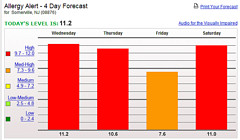
Here’s a screenshot of the allergy alert for Somerville for the next few days. Yep, still a problem. I’m taking generic Zyrtec now, which seems to be working a bit better than the generic Claritin was, but it’s still not quite got me back to normal.
Take Command v.11
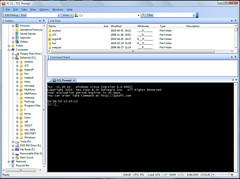
I’ve been using products from JP Software for years, since back in the days of DOS. Their original product, 4DOS, was a replacement for command.com, the old MS-DOS command shell. Their current product, Take Command, is basically a replacement for CMD.EXE, with a bunch of enhancements and random bells & whistles. I hadn’t upgraded in about three years, so I went ahead and did that today. It’s a very nice program, with the enhanced command line embedded in a file browser. Maybe I’ll post some more details when I get a chance to play with it some more. I’m conflicted on whether or not I should invest too much time in learning the new stuff in TC. From a career standpoint, I should probably concentrate on PowerShell. But honestly, I know I can get stuff done faster and easier with TC.
Oh, and I took the screen shot shown here with Jing, which I haven’t used in quite a while. Since the last time I used it, it seems that they’ve added the ability to upload your screen shots to Flickr, Twitter, and Facebook. Nice.
keeping busy
This will be my first full week unemployed. I spent time today taking care of a bunch of random things, including entering a bunch of Merrill Lynch statements into Quicken. They’d been piling up since April 09, so it was almost a year’s worth. I got through to December, so I’ve gotten to the end of 2009, at least.
When I look at my overall financial picture in Quicken, it doesn’t look too bad. Unemployment won’t be a big problem for the time being. My goals for this week include catching up on paperwork (like those Merrill statements), doing whatever I might need to do on my parents’ estates, and studying for my first .Net exam. I may try to take that exam at the end of this week, if I think I’m ready.
WonderCon 2010

I just spent the last 30 minutes or so browsing through photos from WonderCon on Flickr. Wish I was there! Maybe next year.
Allergies
Happy Easter. My allergies have been bothering me a lot lately. (At least I think it’s allergies.) I took a generic Claritin last night before bed, but it really didn’t help much. This morning, I ran out to Walgreen’s and picked up some generic Zyrtec (Wal-Zyr). I just took one, and I sure hope it works.
WonderCon 2010
Packed show floor image – WonderCon 2010 draws in S.F. (photos) – CNET News
Well, I’m not in SF at WonderCon this weekend. Maybe next year.
Nor did I buy an iPad today, though I did go to the Apple Store with a friend when he picked up his. I’ve almost justified getting myself an iPad, under the theory that attending WonderCon would have cost much more than an iPad, between the plane fare and the hotel, so I can spend some of the money I would otherwise have spent on WonderCon on an iPad. Yeah, I know the logic doesn’t quite hold up.